
At the Water Table: Establishing a Watersheds Bill of Rights with Michelle Holman and Rob Dickinson
This interview was conducted by Erin Kanzig on December 15, 2025, and has been lightly edited.
In Lane County, Oregon, grassroots organizers have worked tirelessly to get a measure on the ballot to establish a Watersheds Bill of Rights, which will be voted on in May 2026. Rob Dickinson, a member of the Protect Lane County Watersheds Steering Committee and Campaign, and Michelle Holman, one of the chief petitioners of the Lane County Watersheds Bill of Rights Initiative, share their insights on how to organize for future generations and for flourishing waterways. If you’ve been curious about the “Rights of Nature” movement, this local example will inspire you.
Listen to the recording of the interview here:

Erin Kanzig, River Network: Welcome, Michelle and Rob. To get started, can you please introduce yourselves and share your role with the Protect Lane County Watersheds campaign?
Michelle Holman (she/her): I’m Michelle Holman, my pronouns are she and her, and I’m one of the chief petitioners of the Lane County Watersheds Bill of Rights Initiative.
Rob Dickinson (he/him): Hi, and I’m Rob Dickinson, I use he/him. I’m one of the organizers with the campaign team.
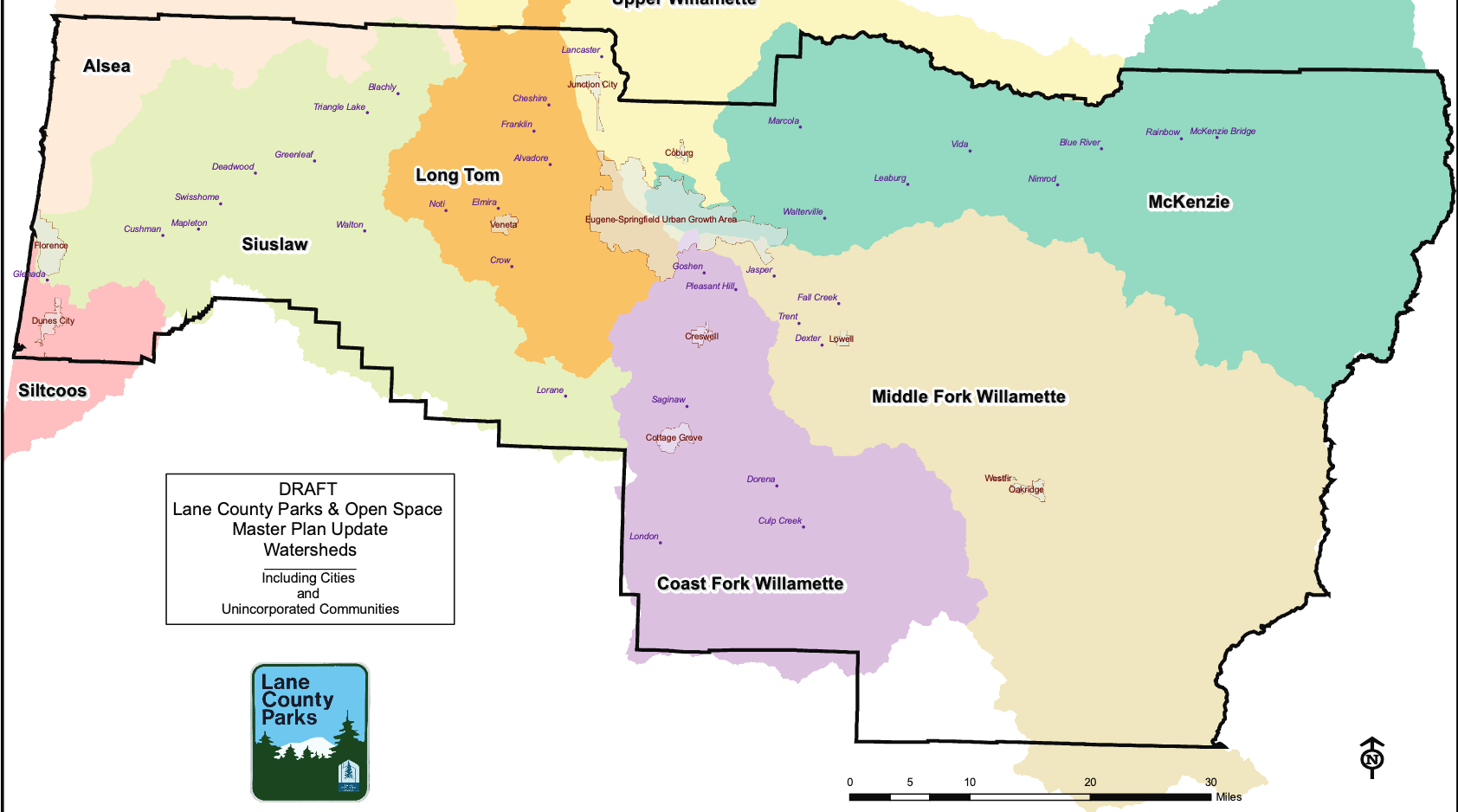
Erin: Thank you for that. And Michelle, to ground our audience in the place-based work you do, can you describe the rivers and watersheds of Lane County, Oregon, and what’s your relationship like to these water bodies?
Michelle: Lane County is a very large, geographically encompassing county, so it goes all the way from the ocean to the foothills of the Cascades. And I live in the coast range; I live right on Deadwood Creek, which drains into the Siuslaw River. Right in my backyard, the salmon right this minute are back there spawning. It’s very cool. I have a really deep, deep love and appreciation for living on a water body. I grew up in Southern Oregon; I grew up on the Applegate. Water is everything. You know, water is life, as we say. So, on the Applegate, when I was in college, they put up a dam, the Lost Creek Dam, I think they called it. And they actually flooded all of our stomping grounds. All the cool places that we used to hang are now underwater, and it’s not even for hydropower. It’s just a recreational dam, so powerboats are on there, and you can imagine – I’m not a fan.
Erin: Michelle, do you have an event or memory from your childhood or adolescence, which I know you just touched on a little bit, but is there any other event or memory that you want to… to highlight that foreshadowed why you’re doing the work you’re doing today?
Michelle: Too many events to mention. I really was a water otter of sorts, and being with my friends on the river in the summertime was, no pun intended, a watershed event, really. I mean, all of those events were watershed events, so I can’t say that I have one specific memory. I was always on the water.
Erin: Rob, do you want to share an event or memory from your childhood or adolescence that shaped why you’re involved in the work you’re doing today?
Rob: When I was a teen, I was with Boy Scouts, and we did a lot of backpacking and always out in the wilderness and along the rivers and creeks and lakes, and it was just a great part of growing up. I was in California before moving to Oregon. Our family moved to rural Oregon, where we live on three acres, and for us, it was really important to be near water, and so we live on Soap Creek along the Willamette.
It’s really just really important that we have this proximity to water, that we left a certain part of our property unfenced into the river so that there’s a wildlife corridor there, and there’s all these deer and beaver and other things going on. It’s nice to have them there.
Michelle: I’m gonna add something, because it just occurred to me that this is a really… a beautiful little snippet. When I was in my early 20s, my partner and I lived up the creek here in Deadwood, on the confluence of two creeks, of Deadwood Creek and Rock Creek, and we actually put our tent right there, and lived there. When we decided that we were going get our own place, we were looking, and we found this place down the creek a ways, on the confluence of two creeks, Deadwood Creek and Deer Creek. So, somehow, I am just cushioned between two creeks. I have been for 40-some years.
Erin: Wow. Thank you for sharing that snippet, Michelle. Rob, this upcoming May, voters in Lane County will have the chance to pass Measure 20-373, known as the Watersheds Bill of Rights. Could you please describe the importance of the Watershed Bill of Rights, and what the journey has been like to get it on the ballot?
Rob: Sure, well, it’s really a groundbreaking piece of legislation in the fact that we are going to really introduce a new way of protecting the watershed in Lane County and giving the watersheds protection that doesn’t exist currently in terms of preventing corporate harms, where there’s certain industrial activities that happen in Oregon that are both very detrimental to the watersheds and to the clean water, but also to humans and animals.
For example, it’s a big thing in Oregon with clear-cut logging, where they will cut down all the trees in a stand, then come back through … and spray herbicides. People breathe that in, and they get sick, and they get cancer, and they get all kinds of different health consequences. Those herbicides that are sprayed on all the plants in an area will ultimately flow into the rivers and springs and pollute the water. Animals will drink that water, and so forth. There’s just huge consequences to some of these terrible practices. And they’ve been going on for 50 years, and many people, like my friend Michelle and others, have been fighting this for decades. And we haven’t been able to get the legislature to do anything.
This is an effort to allow our local community to take a stand for our own health and safety, and to enact law in our county that would stop these activities, and that would recognize that both the watersheds have rights to exist and flourish, and, have sustainable recharge, and so forth, and to be free of that kind of pollution and harm that comes from these industrial activities. And it also recognizes that we humans have a right to clean water, that’s necessary for us to live and to live safely. And it puts those rights into law and also puts in place the prohibitions against certain activities that would infringe upon these rights. So, we think that’s essential, and it’s a model that we would like to see happen in other counties in Oregon and other states as well. We’re really looking forward to passing this measure.
Erin: Thanks for that, Rob. If I could ask a follow-up question, you alluded to the fact that this has been an effort that spans decades. I’m just curious if you could talk a little bit more about what the process looks like for getting something on the ballot? Have you tried before and failed? How have you reached the point that you’re at today?
Rob: We’ve been at this for a bit. Our group has been around roughly for, at least 12 years, maybe 13, and we have tried before. We get a lot of corporate opposition to our work, and typically, there have been… we had another attempt at an initiative like this previously, and the fancy lawyers for the big industrial interests sued the county and managed to come up with some convoluted argument for why we should have to be kept off the ballot before.
We started this current initiative in 2019. They tried to keep us off the ballot by trying to change the ballot title to be something that would, of course, be unworkable, and we ended up having to go to court for that. It finally got cleared to go collect signatures. We have to collect a lot of signatures to get on the ballot. And then the pandemic hit, and that wasn’t a good time to collect. So, this is another iteration that we were able to collect signatures. We collected 15,000 signatures, and now we’re finally on the ballot. It’s been a struggle. We’ve been at it for a long time, but we have not given up.
Erin: Thank you for that extra background, and good on you for keeping at it for all those years. Michelle, the Rights of Nature movement is a growing global phenomenon, but it’s being expanded mostly at the very local levels. I’m curious, what kind of messaging has resonated with community members, and what kind of tactics has your campaign found effective to build support for a concept that might be challenging for some to wrap their heads around?
Michelle: Yeah, well, corporate overreach is a unifier in itself. It crosses political stripes. If you ask a very conservative person, or a progressive person, and people in between on the continuum, “how do you feel about corporations having more rights and privilege to do harm in your communities than you have to protect yourself?” And really, nobody loves this. I mean, like I said, it’s a unifier. It brings people together around the notion that corporations have usurped privileges and powers that really they have no business enjoying.
We’re hell-bent on empowering people to challenge this, and that’s one of the reasons that this initiative is gaining steam, because people feel like, okay, this is the way the people legislate. That’s what the initiative process is, and not every state has the initiative system. So, we’re particularly fortunate that we do, and we’re encouraging people to consider themselves part of the government. We are the missing link in the government. You have your legislature, and you have the judiciary and the executive, but hey, we’re the people, and really, it’s all founded on us. One of the main tactics is to encourage people to understand that that’s their right and their responsibility. We have to do this for generations to come. If you wait for your government to protect your waters, you’re gonna be waiting an awfully long time. We don’t have that time anymore, so we’re doing it ourselves
And then, the rights of nature movement – initially, when we started in 2012, we were actually advised, “don’t use ‘rights of nature.’” Don’t use that phrase, because people don’t know what you’re talking about and it’s alienating. And over time, over these 12 plus years, it’s normalized. It’s become more normal. You see it on social media, you see it in commercials, when you’re watching a sporting event. Rights of nature is not as strange a concept as it once was. And like you say, it’s a global phenomenon. I mean, Ecuador, Bolivia, New Zealand, Uganda, Panama, Colombia, I mean, it’s growing, and in some of those cases, in some of those countries, it’s not just local, it’s actually ensconced in their constitutions. We’re building upon it.
Erin: Rob, touching on that in terms of being connected to other organizations or groups that are also trying to advance this similar type of concept, can you talk about how you’re connected with other rights of watersheds or rights of nature movements in other parts of the country? And any specific examples that have inspired you?
Rob: There’s quite a number of examples that are inspiring to us, that I think I’ll point out two, if I could. Well, the first, a fairly major effort that was successful was the Lake Erie Bill of Rights, which is in Toledo, Ohio, which is a fairly populous area. Lake Erie was basically being contaminated by agricultural runoff, excess fertilizer, which was causing these algae blooms, which was making the water unsafe for people in the area. And a group of concerned citizens got together and wrote the Lake Erie Bill of Rights, which would grant the rights of nature concept and the rights to exist and flourish and be protected from harm by industrial activities. And amazingly enough, this small grassroots group was able to pass that into law, which was pretty impressive. And that’s a big area, a big campaign, and they had a lot of opposition, and still they managed to get voters to understand this rights of nature concepts. So, in terms of what Michelle was talking about earlier, that’s a case where a very large populated area, this notion of rights of nature was not so out there, they were able to pass it. They were able to get people on board and understand that this is a model, so that’s pretty inspiring.
And then, close to home, Lincoln County, just on the coast, not far from us, our friends and neighbors in Lincoln County had a law that was very similar to one we were trying here in Lane County to ban aerial spraying, the practice I talked about earlier. And this was a very small grassroots group with very little money, and the industry came out against them like nothing else, just, all kinds of lies, all kinds of attacks. They were outspent 100 to 1. I think they probably had $20,000 for the whole campaign, and millions of dollars were spent against them.
They still won by 67 votes, so that’s pretty inspiring. They were a small group, we came and we helped them too, but it was a really, just an inspiring example. It really gives heart to the whole work. Their work… actually, both of those examples, unfortunately, shows the extent to which our government doesn’t always work for us. The Lake Erie Bill of Rights was ultimately overturned, and it was kind of an inside job, politicians on both sides, sided with industrial interests, and said that the Lake Erie Bill of Rights was too vague and couldn’t be implemented practically, and they kept that from being enforced. And then in Oregon, the Forest Practices Act, they basically prohibit local governments from regulating pesticides, and it’s what’s called state preemption, where, essentially, if you can capture the legislature and get them to do your bidding, you can prevent local governments from protecting themselves. It was ultimately kept out of being enforced. It was overturned, essentially, because of state preemption. But still, it was a win, the fact that the voters there chose to protect themselves.
And another thing that was really interesting is; it was a two-year legal battle after the election, where there was no spraying in Lincoln County. And during the campaign, the timber interests basically said that if they aren’t allowed to spray, the industry would fall apart, the economy would collapse, basically apocalypse of Lincoln County. But the aerial spraying didn’t happen for two years, and lo and behold, the world didn’t end, and it sort of proves that those claims were false. We’re going to see those same kind of claims here, but we can point to the fact that in Lincoln County they were able to pass the measure and the world didn’t end, and in fact, people weren’t sprayed for 2 years, and people didn’t suffer those same terrible consequences, those health harms that would have happened during those two years.
Erin: Thanks for both of those examples. Could you share where others might find helpful resources or information if they want to learn more about other examples and initiatives around the country, like those that you just shared about?
Rob: Well, if you look at our website, the Community Rights Lane County website, we’ve done a number of presentations on rights of nature, and we have a national expert in town, in Eugene. Craig Kaufman is a professor at the University of Oregon. Much of his academic focus is on the rights of nature, and he’s traveled around and consulted with different countries and different groups on that, and he’s given a number of great overviews of both the concept of rights of nature and the work that’s going on in the United States, but also in different countries, in India, and in New Zealand.
And we’ve had talks at the Public Interest Environmental Law Conference in Eugene, and probably videos of that are on our website. And I would encourage people to look at Craig Kaufman’s work. He has built a website, he and his graduate students, I believe, has built a website called ecojurisprudence.org, which is a visual website, a global map of all of the Rights of Nature movements, Rights of Nature legislation. You could go to Lincoln County, click on that, and you’d probably see their law, and it’s actually pretty fun.
Michelle: I would also suggest that people check out celdf.org – it stands for Community Environmental Legal Defense Fund, and they’ve been kind of our guides through the process, so they have had their fingers all over the globe as well, and there’s just any number of examples and resources there.
Erin: Michelle, in the body, in the text of the Bill of Rights, it outlines both the rights of watersheds and the right to water for people. Many River Network member organizations focus on watershed health, quality, and flows, or drinking water access, affordability, and drinking water quality. Why is it important to you to include the inherent rights of watersheds as well as the human right to water in the bill?
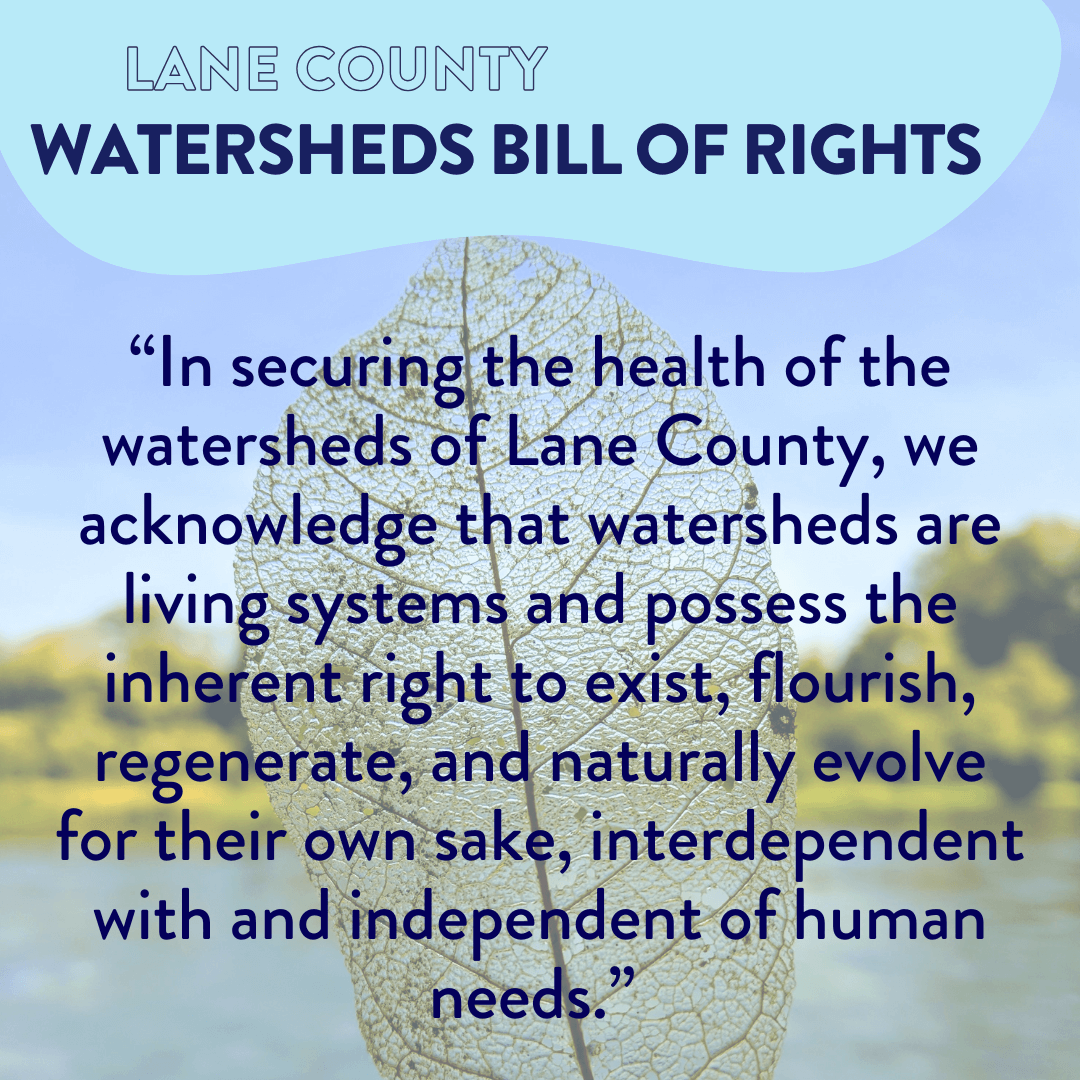
Michelle: I would point out that nature doesn’t just exist for humans’ enjoyment. Nature exists for its own needs. In fact, from the text of our preamble, I’m going to read one sentence:
“In securing the health of the watersheds of Lane County, we acknowledge that watersheds are living systems and possess the inherent right to exist, flourish, regenerate, and naturally evolve for their own sake, interdependent with and independent of human needs.”
Humans tend to be pretty self-focused and clueless. I’d say another way that we are clueless is that we separate ourselves from nature, and really, we just … we are nature, we’re just another species, albeit the most damaging, but we are nature. I think once people can understand that notion, then our responsibility to the big picture is even more important, and we have to take it very seriously.
Erin: Rob, in the final months before voters cast their ballots, what does your education and outreach plan look like?
Rob: Well, our challenge is to get our message out in such a large, diverse, and geographically spread out area without the financial resources that we’d really want for a campaign of this size. We’re going to rely on a person-to-person outreach and volunteer campaigning and trying to get earned media to get our message out. So, journalists like yourself are helping by informing other people about our work. You can’t send lots of mailers to get into people’s mailboxes and so forth, and you can’t do a lot of television or radio ads, so you have to do it in a grassroots fashion. Very much person-to-person, grassroots, getting out in the community, we’re planning a whole series of speaker events for January, February, March, and April as well, to hopefully educate people on the importance of water, watersheds, and also different kinds of great work that is related to protecting the environment. And we will inform people about our measure at those events.
We’re doing a series of house parties, getting anybody who we know who’ll bring half a dozen or more people to their house, and we’ll show up, and we’ll talk to them, and hopefully they will get involved, and hopefully donate, which is what we need. Doing what we call “clean water coffees,” just showing up at different coffee shops in different parts of our county, and meeting with whoever will come, and trying to bring them on board, to get more supporters, and hopefully volunteers. There’s a thing called the Holiday Market in Eugene in our county, where lots of craft vendors are out, and we’ve got people that have shown up there, getting literature out to people. We’re planning on doing a lot of work dropping off literature to households; grassroots canvassing essentially.
But it’s a big lift, because Lane County is a big county, and we’re a small group, and we don’t have a huge bank account to rely on for the campaign. We’re just building this campaign from the ground up, hoping to get both volunteers and donors, people to give us a little money that we can use for all of what we’re doing. And, you know, it’s gonna be a busy six months.
Michelle: We do also invite ourselves to ally organizations, to their meetings. We try to talk to their membership, and if they have events, we table at their events, so we piggyback off of the goodwill that we’ve enjoyed with other progressive organizations, and general organizations. We’ll go to churches, we go to fraternal organizations, I just spoke at the Elks Club, we’ll talk to anybody.
Erin: Yeah, I love your creative ideas of house parties and the coffee shops. Rob, assuming the Bill of Rights is passed, what do you envision it doing in the next 10 years for Lane County’s watersheds? Describe what you imagine the residents, watersheds, ecosystems, and natural communities might feel like if the provisions of the bill can be effectively enforced.
Rob: What we’d really like to see is the measure leading to positive changes in various kinds of either forestry practices or agricultural practices that would lead towards much greater health of the ecosystems, and also protections of people. For example, we’d love to see timber harvest – we all still need wood for various kinds of housing and other projects, but we’d like to see that kind of timber harvesting done in a more sustainable model that both boosts the economy, that increases jobs, and also is better for the health of the forest and watersheds. So many people in rural Oregon have been affected by some of these practices of the spraying and the harmful pesticide exposure. We’d love to see a world where that doesn’t happen, where people don’t have to suffer that, they don’t have to have themselves be harmed, and children get contaminated with pesticides, but also animals as well in the water. We’re looking forward to those protections of watersheds and protections for people.
Erin: Michelle, if you want to chime in on how, 10 years from now, what would you envision the Watersheds Bill of Rights doing?
Michelle: I mean, I think Rob just said it. We would curtail corporate privilege, and in that way, they would not be able to harm our precious waters.
Rob: In addition, what we’re hoping for in positive changes in Lane County, the place where we’re passing this measure, we’d like to see the law that we’ve put forward be a model for other counties, so hopefully in 10 years, it won’t be just the law in Lane County, but maybe it’ll be the law in Lincoln County, it’ll be the law in Douglas County, it’ll be the law in lots of different places in Oregon, or maybe other states.
We’d love to see it be a model, and if we can show that it can be done here, then, again, the concept of the rights of nature must not be so foreign, and maybe people understand that right now the environment isn’t being protected, and you need a new model, a new paradigm, and maybe this could be it.
Erin: Michelle, do you have any words of wisdom for community leaders that might be interested in replicating your efforts in their own locality, and if so, how should they get started?
Michelle: Getting started means thinking locally. Like, what is it that your heart and your guts tell you, you need to do here? If it’s the watersheds, it’s a great unifying notion and a good issue, but if it’s your particular watershed, you make it specific to you, and to where you live. People have to feel it. They have to know it. Folks understand that the issues where we live better than anybody else understands them. Oftentimes, these corporations don’t even live in your community, and so they don’t even have to deal with the repercussions of their harmful activities. We know that it’s our responsibility and our privilege to protect where we live.
It makes us incredibly empowered. And more communities doing exactly what we’ve done would be so inspiring. We’re willing to share our law with anybody who wants to look at it. You don’t have to reinvent the wheel. In fact, I had this notion that if everybody was doing a water protection initiative, we’d have these little patchwork quilt squares. I mean, we can make a blanket of protection. Ultimately, if everybody takes care of their watersheds, then the corporations are going to be squeezed out. That’s the point.
I think for me, it was really important for me to investigate and understand the history of people’s movements in this country and abroad. I think it gave me a foundation to be a better organizer.
You really have to play the long game. That’s what I tell organizers all the time. There is a rub there between the earth begging us to do things now, but the reality of change, it just is not happening overnight, and so you just have to never give up. Slavery lasted 400 years, and the abolitionists were at it for decades. Women’s suffrage took over 200 years, you know, so when you look back at the way people dug in, and a lot of the originals died before they saw the results. So, we’re not delusional. We know that this is the long game, and probably many of us will not be here to see the fruits of our labor. But, we know full well what a justice-filled world looks like. We know what we’re after, and you don’t stop until you get there. I think it’s like Angela Davis says, “Act as if it were possible to radically transform the world, and you have to do it all the time.”
Erin: I just want to let you know that that’s my mantra that I repeat to myself every day.
Rob: Wow, that’s awesome.
Erin: Thank you both so much. This is a super inspiring conversation, I really appreciate the time. Is there anything else that you’d like to share that we didn’t touch on so far before we close out?
Rob: Yeah, I kind of hit on this before, but the challenge before us is huge. We’re just a small group of volunteers, we’re just regular people, we don’t have any huge corporations backing our effort, we don’t have a whole lot of wealthy donors, in fact we don’t have any. We just hope your audience, regardless of where they live, will see our work as being important, and not just in one county, but all over.
And this is groundbreaking legislation, and the passing of a measure could have impacts far beyond our community. So, we just hope that your audience, if they don’t have a campaign like this in their area, if they don’t have a way to protect water where they live, maybe they can lend us a hand, because we could use it.
Explore the resources mentioned by Rob and Michelle below, along with some other news and resources about rights of nature efforts.
- Community Rights Lane County website
- Protect Lane County Watersheds website
- Craig Kaufman’s Blog
- Public Interest Environmental Law Conference in Eugene
- Eco Jurisprudence Monitor
- Community Environmental Legal Defense Fund
- Watersheds Bill of Rights Heads to Lane County Voters, McKenzie River Reflections, September 18, 20205
- The Tribal council of the Colorado River Indian Tribes recently recognized the CO River as a legal person under tribal law.
- The Yurok Tribe in northern California declared the Klamath River a legal person in 2019.
You can support the Lane County Watersheds Bill of Rights Initiative by donating here.