
Change and Challenge Across the West
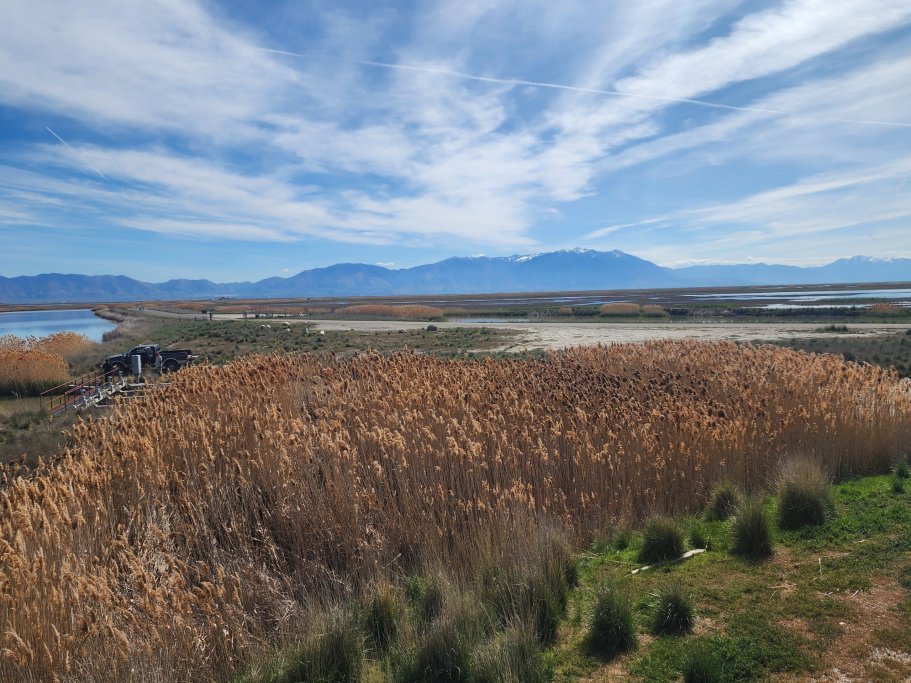
The American West is gearing up for a challenging water year, with devastating fires already burning across the drought-stricken region. Snowpack, the West’s largest natural water source, hit a new benchmark low for Wyoming, Utah, Colorado, and New Mexico. Among the water bodies feeling the stress of this crisis is the Great Salt Lake. Known by the Western Shoshone tribe as Pia-pa, meaning “great water,” the Great Salt Lake is making headlines. Despite the work of federal and state governments to enact policies that restrict water consumption, incentivize water conservation practices, and implement drought mitigation, the Great Salt Lake may disappear entirely in the next 5 years.
This threatened landscape was an anchoring setting for River Network’s 8th Environmental Flows Workshop, held over 3 days in Salt Lake City, Utah.
As water practitioners, scientists, government agencies, tribal leaders, and nonprofits gathered to develop collaborative solutions for restoring environmental flows and water levels across the West, we heard many practical solutions and pieces of wisdom from folks working on the ground to restore flows.
For example, the Colorado River Authority (UT) is piloting a Demand Management Program to address water quantity and flows in the Colorado River Basin. We heard from the Deschutes River Conservancy (OR), which is working to protect the Columbia River Basin in a shifting political landscape. The Walker Basin Conservancy (NV) and the Texas Water Trade are navigating groundwater management frameworks in their respective states. And The Nature Conservancy in California is developing state policy guidelines to protect groundwater and surface water.
If uncommonly early wildfires and record low snowpack weren’t challenging enough, these states are also dealing with dwindling investments at the federal level. The reduction and reallocation of federal dollars resulted in several conversations at the Environmental Flows Workshop.
We discussed what it would take to fill the gaps left by government funding through private investments, corporations, and foundations. While those dollars may continue to fund on-the-ground restoration work, they are similarly limited by region and scope. The reality is that accessing those private dollars will require more collaboration across all stakeholders and water users, many of whom are not typically invited to participate in water allocation decisions. This is a problem that this group is working to solve.
In recent weeks, the Bureau of Reclamation announced they will release $35 million to Utah for drought mitigation projects in the Colorado River Basin. These dollars are only a third of what was originally appropriated before the 2025 federal funding freeze. The is still a dire need to explore additional funding avenues.
Another discussion focused on how we tell the story of the western water crisis. How do we keep the public informed, especially those whose water accessibility is most at risk? Local media—newspapers, in particular—emerged as a solution. We also highlighted the potential for religious institutions to share information with their congregations.
We heard from a representative of the Navajo nation about the consequences the Navajo nation faces when they are repeatedly excluded from the decision-making table. Currently, legislation is stalled in Congress that would allow autonomy and economic stability for Arizona’s tribes, many of whom do not have access to water in their homes.
The solutions that emerged were inclusion and education. Participants noted the urgent need for all water users (i.e., everybody) to become part of water use and planning discussions. If everyone understood the consequences of a worsening drought and poor allocation decisions, the table would be wonderfully crowded.
This conclusion comes up time and again at the Environmental Flows Workshop: the current table of water decision-makers is not big enough.
This is the value of a convening like the Environmental Flows Workshop, which is one of the only peer networks for environmental flows practitioners. It is impossible to overstate the impact of regional experts coming together to share experiences and create solutions.
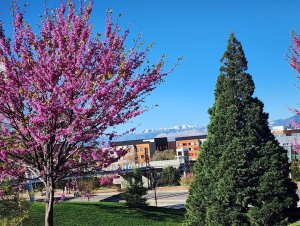 In mid-April, as the sun rises over the Wasatch Mountains to the east of Salt Lake City, there was still some visible snowpack. The magenta pink of the western redbud (Cercis occidentalis) lines the campus walking paths and courtyards. But day two of the Workshop is all about the water body that gives this City its name: the Great Salt Lake.
The field trip began with a primer on the climate and human impacts affecting the Lake and planning efforts to protect it, especially as the city looks to host its second Winter Olympics in 2034.
The challenge facing the Great Salt Lake is one that is shared across the West: the amount of water available to meet the demands of people and nature is largely dependent on the amount of annual snowmelt. As climate trends continue to show drier and warmer winters in the greater Colorado River Basin, the amount of water available to meet the needs of people, food growers, recreationists, and the rivers themselves continues to tighten. A decline in snowmelt means there is less water flowing into streams, rivers, and groundwater sources, many of which serve as the primary water source for drinking water.
Climate is inherently variable. Scientists and researchers are generally able to predict both drought and drought relief, but not on longer timelines and not with absolute accuracy. This makes long-term strategic planning decisions for water organizations in the West incredibly challenging. And then there is the ticking clock of multi-state management of the Colorado River, which must be decided by the end of 2026.
Both of these factors are driving up uncertainty for flows practitioners in the West. River Network’s role, as always, is to create a space for the human connection that makes this highly technical work possible. Spaces like the Flows Workshop are for community-building: so that the next time they’re struggling to get a message across, facing a threat to Tribal water rights, or troubleshooting a restoration method, they can pick up the phone and call a friend.