
State Policy Showcases
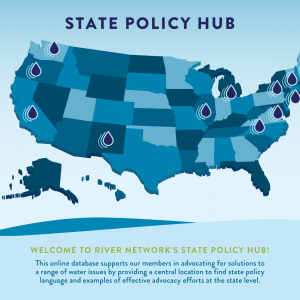
River Network’s State Policy Hub is a one-stop-shop for state policy examples touched on in our State Policy Showcases.
Visit our Events and Learning page for any upcoming State Policy Showcases.
State Policy Showcases are one-hour peer calls for organizations working and advocating for change at the state-level.
Each showcase focuses on a state policy success, often comparing two states’ approaches to the same water issue, and includes the following:
- Policy Nuts-and-Bolts (what the policy does, how it works)
- How-To (what it took to get the bill/policy/decision passed, advocacy strategy, etc.)
- Q&A
- Discussion
Past State Policy Showcases
Click on the tabs below to view past State Policy Showcases and resources.
State Funding Programs for Water (April 2026)
States highlighted: Delaware, Texas
Guest Speakers: Usman Mahmood, Policy Analyst at Bayou City Waterkeeper, and Mark Nardone, Director of Advocacy at Delaware Nature Society
Some states have created comprehensive initiatives to address their most pressing water issues in combination with sustained funding. Texas’ recent Prop 4 ballot initiative, which was passed by voters in November 2025, dedicates $1 billion per year for the next 20 years to Texas Water Fund, a state fund established to finance water projects in Texas. In Delaware, the Clean Water Initiative for Underserved Communities, funded through the Clean Water Trust, delivers critical support to infrastructure projects.
Resources:
- Value of Water Campaign: The Economic Benefits of Investing in Water Infrastructure and State Fact Sheets
- Water Program Portal: State Fact Sheets on Federal Funding for Water Infrastructure
- Texas Living Waters: A Landmark Vote for Texas Water: What Proposition 4 Means for Our Future
Aquatic Litter and Extended Producer Responsibility (August 2025)
States Highlighted: California, Oregon
Guest Speakers: Dr. Anja Brandon, Ocean Conservancy, and Nicole Portley, Oregon Department of Environmental Quality
This State Policy Showcase touched on state policies that address plastic pollution and aquatic litter through Extended Producer Responsibility (EPR) initiatives in California and Oregon. The guest speakers covered the nuts-and-bolts of each state’s EPR policy, as well as the strategies and enabling conditions that led their state leaders to act. Following the case studies, there were group discussions on topics such as the key components needed in a policy tackling the widespread issue of litter and pollution, where these policies might be ripe, barriers and roadblocks you’re likely to encounter, strategies you’d use to overcome barriers, windows of opportunity you’d look for, coalitions you’d want to build, and other strategies you see are needed to successfully advance this type of policy.
Resources:
- California SB 43
- Oregon Department of Environmental Quality: Press Release
- Ocean Conservancy: Tackling Plastic Pollution Through Producer Accountability
- Ocean Conservancy: United States of Plastic Report
- Oregon’s Plastic Pollution and Recycling Modernization Act
- Resource Recycling, Inc: Oregon is first to approve EPR Plan (2025)
- National Caucus of Environmental Legislators: Policy Brief: Washington State Passes EPR for Packaging (2025)
- River Network: State Policy Hub
Approaches to Floodplain Restoration and Protection (March 2025)
States Highlighted: Vermont, Washington
Guest Speakers: Kathleen (Kas) Guillozet, Senior Director of Bonneville Environmental Foundation’s Watershed Program, and Mike Kline, River Ecologist and former State of Vermont’s Rivers Program Manager
In this State Policy Showcase, two experts talked about state-level floodplain restoration and protection policies in Washington and Vermont, including the nuts-and-bolts of the policy, what drove action by decision makers, and the lessons they and their team learned in the processes. Both states’ policies and the speakers are newly featured in River Network’s State Policy Hub.
Resources:
- Washington’s Floodplains by Design Program:
- Vermont’s Functioning Floodplains Initiative:
- Vermont Department of Environmental Conservation: Functioning Floodplains Initiative
- River Network: Lessons from Vermont’s Functioning Floodplains Initiative
- River Network: Lessons from the Network: Mike Kline
Reducing Exposure to Lead in Schools and Child Care Centers’ Drinking Water (June 2024)
States Highlighted: Colorado, Michigan
Guest Speakers: Alexandra Simon, Public Health Advocate with CoPIRG, and Cyndi Roper, Natural Resources Defense Council
No level of lead in drinking water is safe, especially for growing kids. In this State Policy Showcase, our guest speakers discussed policies in both Colorado and Michigan designed to help protect children from exposure to lead in drinking water at schools and child care facilities.
Resources:
-
Environment America: Get the Lead Out Toolkit
-
Environment America: Grading the States on Protecting Kids’ Drinking Water at School
-
Environment America: Lead & Copper Rule Improvements comment letter to EPA
-
Environment America: Lead in Schools’ Water
- NRDC – Get the Lead Out of Drinking Water in Schools: Model Law
- Colorado:
- Denver Water: Lead Reduction Program
-
Colorado Department of Public Health and Environment: Colorado Test and Fix Water for Kids
- Michigan:
Addressing PFAS in Pollution Discharge Permits (January 2023)

States Highlighted: North Carolina
Guest Speaker: Geoff Gisler, Senior Attorney with the Southern Environmental Law Center
In this State Policy Showcase, Geoff Gisler shared how advocacy by conservation groups and residents in North Carolina led to the strongest limits on PFAS in a Pollution Discharge (NPDES) Permit in the nation, as well as new guidance the Environmental Protection Agency (EPA) developed for states on addressing PFAS discharges.
Resources:
- Southern Environmental Law Center:
- EPA:
- Addressing PFAS discharges in NPDES permits and through the pretreatment program and monitoring programs (2022)
- Meaningful and Achievable Steps You Can Take to Reduce Your Risk
- PFAS Analytic Tools
- PFAS Strategic Roadmap: EPA’s Commitments to Action 2021—2024
- Health Advisory FAQ
- Infographic on the Bipartisan Infrastructure Law
- Small and Disadvantaged community grant program details
- Reducing PFAS in Drinking Water with Treatment Technologies
- Other:
- CDP: PFAS Study Findings
- Colorado Sun: CO water system using other water supply to dilute PFAS-contaminated water
- Star News: Chemours takes EPA’s new GenX health advisory to court claiming agency’s science is wrong
- American Rescue Plan Act: Final Rule about eligible water infrastructure projects
- National Conference of State Legislatures: ARPA tracking tool
- SaferStates: PFAS Legislation Tracker (2026)
- River Network: State Policy Hub – PFAS
- River Talks Podcast: PFAS Episode
- National PFAS Contamination Coalition
- Earthjustice: Tracking the EPA’s PFAS Roadmap Progress
- Eureka Alert: Water Cleanup Method Destroys PFAS
Environmental Justice (May 2022)
States Highlighted: New York, Oregon
Guest Speakers: Anthony Rogers-Wright, Director of Environmental Justice from New York Lawyers for the Public Interest, and Jairaj Singh, Climate Resilience and Environmental Justice Director from United Oregon
In this Showcase, our guest speakers highlighted the Climate Leadership and Community Protection Act and a new cumulative impacts bill, as well as an overview of Oregon’s Environmental Justice policies, including recent legislation to create an Environmental Justice mapping tool.
Resources:
Nutrient Reduction (May 2022)

States Highlighted: Illinois, Maryland
Guest Speakers: Evan Isaacson, Chesapeake Legal Alliance; Doug Myers, Chesapeake Bay Foundation; and Cindy Skrukrud, Illinois Nutrient Research & Education Council and Fox River Study Group
Resources:
- Maryland’s Blueprint for Clean Water
- CLA Celebrates Maryland Senate’s Approval of SB0492/HB0649
- Illinois Nutrient Loss Reduction Strategy Implementation
Interested in further discussion and action on tackling nutrient pollution issues? Join the Nutrient-Reduction Forum.
How States Can Use Federal Covid-19 Relief Funds to Pay for Equitable Water Infrastructure (2021)
State Highlighted: Virginia
Guest Speaker: Anna Killius, James River Association
We forgot to hit record on our Showcase about how states are allocating American Rescue Plan Act (ARPA) funds for equitable water infrastructure. Below are some helpful links to supplement the Showcase, including the slides from Anna Killius’ presentation on Virginia’s priorities for infrastructure investment.
Resources:
- Slides from this Showcase
- WDBJ: Virginia to Reduce Water Pollution, Increase Access to Clean Water
- National Conference of State Legislatures: ARPA State Fiscal Recovery Fund Allocations Database (search by “water infrastructure”)
- Other State News:
- Michigan Senate Approves $3.3B Water Infrastructure Bill
- Texas Living Waters Project: Water Rescue: Using American Rescue Plan Act Funds to Improve Our Fragile Water Infrastructure
- Kentucky: Cleaner Water Grants
- Ohio: BUILDS (Broadband, Utilities, and Infrastructure for Local Development Success) initiative
- Montana: Infrastructure Advisory Commission
- River Network: Funding Water Infrastructure in Your Community with American Rescue Plan Dollars
- Sign up to receive updates from the U.S. Department of Treasury on states’ reporting and compliance related to fiscal recovery funds
- U.S. Department of Treasury: Early Data Shows State and Local Governments Are Committing Recovery Funds to Build an Equitable Recovery
- Final Rule on the Coronavirus State and Local Fiscal Recovery Funds (April 2022)
Human Right to Water (April 2021)
States Highlighted: California, Virginia
Guest Speakers: Jorge Aguilar, Food & Water Watch, and Amanda Monaco, Leadership Counsel for Justice & Accountability
Resources:
Sewage Right-to-Know (June 2021)
States Highlighted: Massachusetts, New York
Guest Speakers: Katharine Lange, Policy Specialist at Massachusetts Rivers Alliance, and Paul Gallay, President at Riverkeeper
This State Policy Showcase discussed Sewage Right-to-Know state policies in Massachusetts and New York. Exposure to untreated, or partially treated, sewage in our waters poses serious health risks. It is imperative that people are sufficiently notified when sewage spills threaten their health and safety. There are currently no comprehensive federal requirements to notify people when there are sewage spills or leaks.
Resources:
- New York’s Sewage Right to Know Law
- Massachusetts’ Sewage Right to Know Law
- Massachusetts River Alliance: Right to Know Info Page
Low-Income Household Water Assistance Program (July 2021)

States Highlighted: National focus
Guest Speaker: Max Gomberg, Water Foundation and former Climate and Conservation Manager at California’s State Water Resources Control Board
This State Policy Showcase focused on the Low-Income Household Water Assistance Program (LIHWAP) implementation. LIHWAP was created as an emergency program to provide funds to help low-income households affected by the COVID-19 pandemic pay their water and wastewater bills, avoid water shut-offs, and support water reconnections related to nonpayment. The program was funded through two Congressional spending packages: $638 million as part of the $2.3 trillion spending package passed in December 2020 and $500 million from the American Rescue Plan passed in March 2021.