

Restoration and Healing on the San Lorenzo River

Early in her career at Coastal Watershed Council, Kaiya Giuliano-Monroy was told that creating a sustainable program for local unhoused folks and restoring the river wouldn’t be possible. Today, she is proud to have created a successful and replicable structure.
Kaiya, a 32-year-old river ecologist, was named the Emerging Leader at River Rally 2026. This award recognizes a burgeoning leader working at the intersection of water and justice, and there is no doubt that Kaiya is just that. For three years, she led the Coastal Watershed Council’s River Steward Program, which engaged people experiencing homelessness with restoration work along the San Lorenzo River in her hometown of Santa Cruz, California.
Before starting the program, Kaiya wanted to find a way to connect unhoused members of the community to the river. Both the river and the people were hurting, and, as someone who cares deeply about water and people, she found this impossible to ignore.
“The more I worked with the [San Lorenzo] River, the more I wanted to protect it,” Kaiya said. Creating an ongoing program that benefited people and nature in Santa Cruz required intentional planning, collaboration, and flexibility when things didn’t work, but Kaiya knew that the effort would be worth the results.
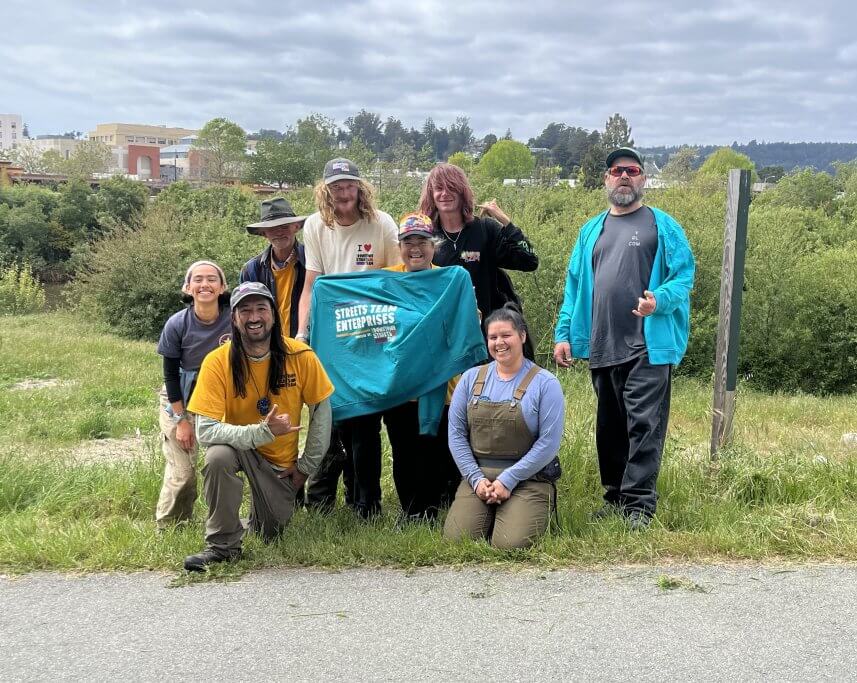
The Coastal Watershed Council partnered with the Downtown Streets Team, a non-profit that supported individuals experiencing homelessness. Together, these organizations provided the River Stewards with food and a stipend each time they volunteered, as well as case management and other support. However, Kaiya’s main goal for the Stewards was to center their humanity and build confidence.
“A lot of [the Stewards] had really low self-esteem I think because of community views of them,” she said. “Reminding them that they are important is helping them through whatever journey they are on. Of course, I want them to get stable employment or stable housing, but before that you have to have stable mental well-being. That was step one.”
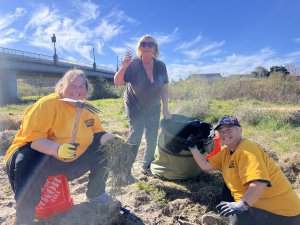
A group of River Stewards prepare to seed native plants along the river.
The River Stewards program started in 2022, but Downtown Streets was one of the many organizations that had to close its doors due to federal funding cuts earlier this year. Kaiya couldn’t continue the program without their partnership, and it had to be paused as a result. However, the impact of Kaiya and the Stewards in those three years was immense. The River Stewards showed up weekly and cleaned up over 200 pounds of trash, removed 3,000 square feet of invasive plants, and planted 1,000 square feet of native species along the river.
“As I met the participants and heard their stories, they really inspired me,” Kaiya said. “They showed up with such gratitude, joy, and community. I felt so uplifted by them. How could I not be inspired by their energy? They were so excited to be there despite everything.”
The goal of the River Stewards program was twofold: restore the San Lorenzo River and provide learning and income-generating opportunities for the unhoused community. The Stewards learned valuable skills about how to work on a team and be part of a restoration project. They also engaged with the ecosystem, learning to identify plant and animal species by their common and Latin names. They cleared thickets of blackberries and other invasive plants, replaced them with native plants, and saw their hard work pay off as other indigenous species returned to the area.
“I loved proving people wrong and really making change and creating biodiversity along the river,” she said.
As I met the participants and heard their stories, they really inspired me. They showed up with such gratitude, joy, and community. I felt so uplifted by them. How could I not be inspired by their energy? They were so excited to be there despite everything.”
– Kaiya Giuliano-Monroy
One of the challenges Kaiya faced while developing the program was meaningful relationship- and trust-building. The River Stewards were sometimes facing extreme hardships in their lives, so leading with compassion and sympathy was essential.
“Just to acknowledge them is really important,” she said. “Bring them into a community and be human to them, because they’re just people like us. “
Her team took the time to learn how to enter these spaces with an understanding of how to support, teach, and show up for their volunteers throughout the duration of their time with the Stewards. She noted that building the program required trial and error, and subsequently patience. They constantly asked for feedback from the volunteers to understand what was and wasn’t working around the length, structure, and opportunities within the program. Ultimately, this all allowed the River Stewards Program to become the success it was.
Since funding dried up, the absence of the program has left a hole in the community. There are plans to restart the program once funding is procured. The Coastal Watershed Council has already made plans to partner with People First of Santa Cruz County, another homeless service provider, when the River Stewards Program does resume.
Kaiya’s work on this program has inspired other cities to create similar programs and often brings people to tears when they learn about the program and its impacts. Her session at River Rally, “Resilience on the River: Lessons from Urban Restoration and the Community That Tended It,” was an emotional gathering that touched on the barriers and struggles that ultimately led to the program’s pause, but the session also emphasized the joy and impact on the river and the people who rely on it.
“We have positively transformed the lower river, and I think in return it has helped heal us all a little, too,” she said.